
Alibaba Cloud
Alibaba Cloud
Public CloudCloud recovery for Veeam administrators
Arcami restores existing Veeam backup data as workloads that can run on Alibaba Cloud, Tencent Cloud, Huawei Cloud, Volcengine, and Baidu AI Cloud.
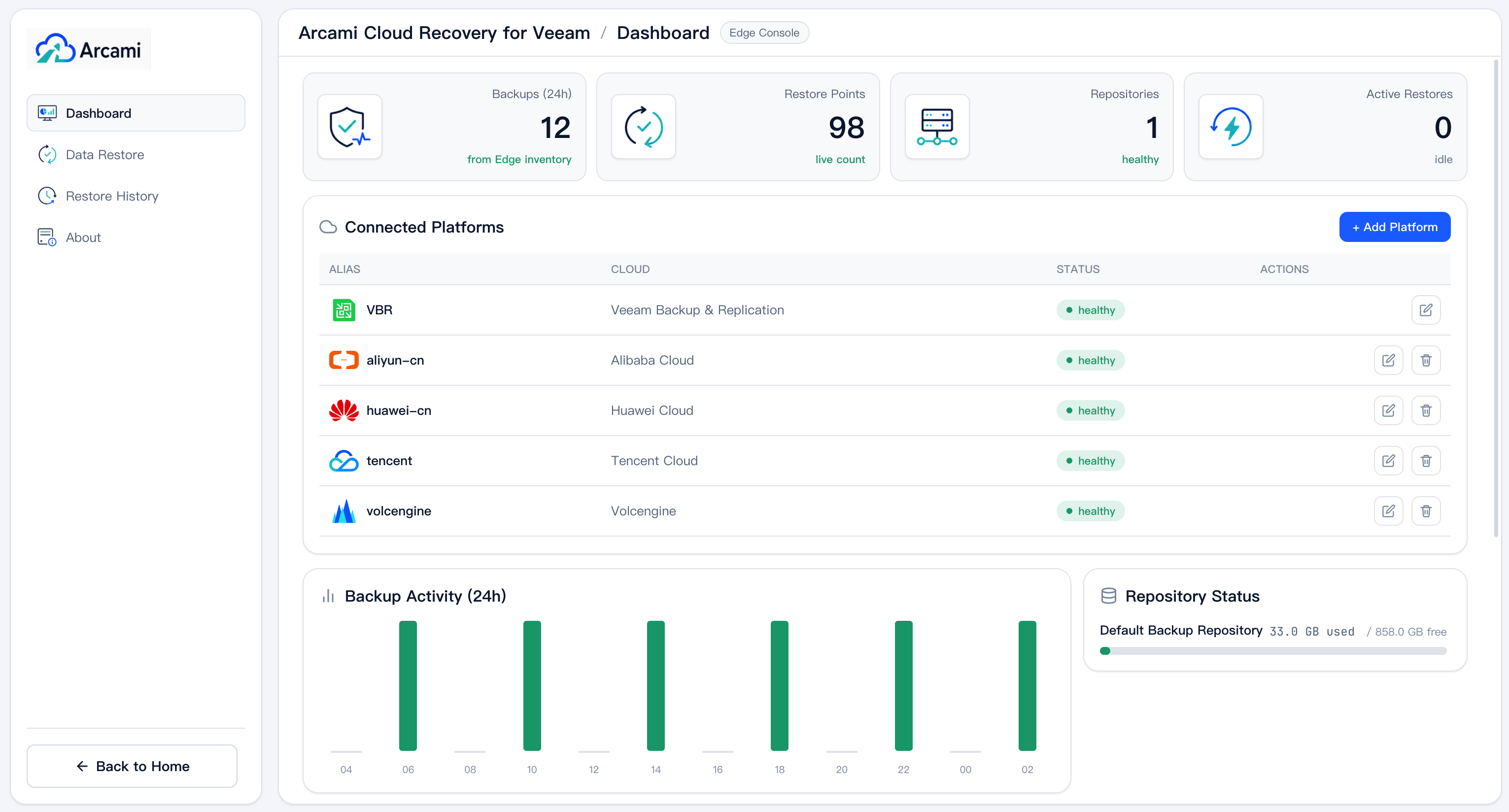
Target Platforms
Arcami packages image import, network mapping, instance sizing, boot validation, and audit evidence into a repeatable recovery workflow that fits different cloud environments.
Alibaba Cloud
Public CloudTencent Cloud
Public CloudHuawei Cloud
Public CloudVolcengine
Public CloudBaidu AI Cloud
Public CloudWhy Arcami
When recovery targets expand into public clouds or private virtualization platforms, administrators often run into image conversion, network mapping, credential scope, cloud quota, boot validation, and audit evidence challenges. Arcami turns those cross-platform recovery steps into a standardized, orchestrated, and verifiable recovery workflow, so Veeam backups do not stop at being recoverable on paper and can actually be restored where the business needs to run.
Before
After
✓Each cloud has different import, networking, security group, and instance sizing steps, which makes manual recovery error-prone.
DR drills and daily recovery validation both need repeatable recovery plans, preflight results, and validation evidence instead of scripts and occasional manual tests.
Backups alone do not prove the workload can boot, connect, satisfy audit requirements, and leave a clean validation record.
How It Works
In three steps, Arcami takes recovery setup from the backup server to the public cloud. Veeam Backup Server, Veeam Proxy, and Backup Repository do not need internet access.
Deploy the edge-side appliance on premises, complete network setup, activate the appliance online, and register it with the SaaS console.
The edge-side appliance connects to the Veeam backup server, scans backup data automatically, and keeps restore point status in sync.
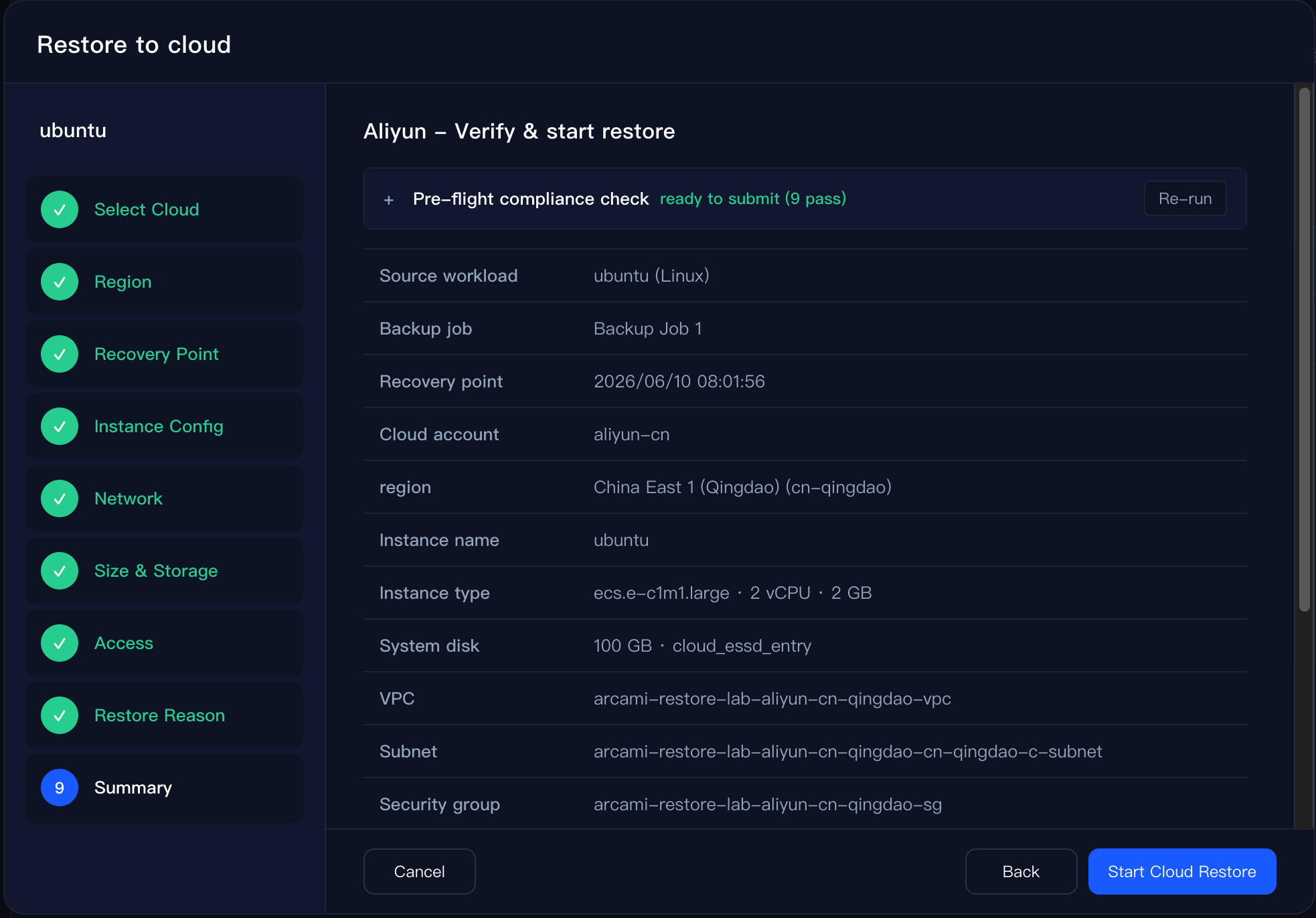
Select the target cloud, launch the restore wizard, run recovery preflight automatically, and restore to the target cloud with one click.
Core Capabilities
Start a recovery plan from existing Veeam restore points and land workloads on the target cloud platform.
Veeam components do not need internet access, and recovery orchestration runs inside the customer environment.
Runs automated daily cloud recovery drills, validates backup usability, and cleans up cloud validation data after each run.
Prebuilt target workflows cover image import, network mapping, instance sizing, boot checks, and cleanup.
Check credentials, network, capacity, and quotas before execution, then validate instance boot, network reachability, and application availability after recovery.
Keep recovery plans, execution timelines, validation results, resource IDs, users, and cleanup records.
Use Cases
Arcami is not about copying backups to a cloud. It helps teams run recovery plans, produce validation evidence, and maintain audit trails.
Recover critical systems to cloud or private targets when a site, platform, or region becomes unavailable.
Run daily automated cloud recovery drills and retain repeatable preflight results, validation evidence, and cleanup records.
Boot and validate backups in isolated target environments to identify usable restore points.
Recover production backups into cloud test environments for realistic engineering sandboxes.
Console Preview
The console is organized around Edge, Veeam backup servers, public clouds, data recovery, Recovery Sentinel, recovery details, and recovery history, so every step is visible from planning and execution to recovery details. Recovery Sentinel can run daily cloud recovery drills and clean up validation data automatically.
Arcami License
Standard includes Recovery Sentinel for up to 5 machines per month; Enterprise adds Unlimited Recovery Sentinel and Cloud Data Use.
Mystery surprise price, coming soon
Designed for cloud recovery validation on critical machines. Recovery Sentinel validates backup usability and cleans up validation data automatically.
Custom terms by scale and use case
Designed for larger-scale continuous recovery validation, recovery evidence, and cloud data use cases.